Water Lily


  • Kingdom      :Plantae
  • Clade            :Angiosperms
  • Order            :Nymphaeales
  • Family          :Nymphaeaceae


Nymphaeaceae /ˌnɪmfiːˈeɪsiː/ is a family of flowering plants, commonly called water lilies. They live as rhizomatous aquatic herbs in temperate and tropical climates around the world. The family contains five genera with about 70 known species.Water lilies are rooted in soil in bodies of water, with leaves and flowers floating on or emergent from the surface. The leaves are round, with a radial notch in Nymphaea and Nuphar, but fully circular in Victoria and Euryale.

Water lilies are a well studied clade of plants because their large flowers with multiple unspecialized parts were initially considered to represent the floral pattern of the earliest flowering plants, and later genetic studies confirmed their evolutionary position as basal angiosperms. Analyses of floral morphology and molecular characteristics and comparisons with a sister taxon, the family Cabombaceae, indicate, however, that the flowers of extant water lilies with the most floral parts are more derived than the genera with fewer floral parts. Genera with more floral parts, Nuphar, Nymphaea, Victoria, have a beetle pollination syndrome, while genera with fewer parts are pollinated by flies or bees, or are self- or wind-pollinated.Thus, the large number of relatively unspecialized floral organs in the Nymphaeaceae is not an ancestral condition for the clade.

Water lilies do not have surface leaves during winter, and therefore the gases in the rhizome lacunae access equilibrium with the gases of the sediment water. The leftover of internal pressure is embodied by the constant streams of bubbles that outbreak when rising leaves are ruptured in the spring.

Description:

The Nymphaeaceae are aquatic, rhizomatous herbs. The family is further characterized by scattered vascular bundles in the stems, and frequent presence of latex, usually with distinct, stellate-branched sclereids projecting into the air canals. Hairs are simple, usually producing mucilage (slime). Leaves are alternate and spiral, opposite or occasionally whorled, simple, peltate or nearly so, entire to toothed or dissected, short to long petiolate), with blade submerged, floating or emergent, with palmate to pinnate venation. Stipules are either present or absent. Flowers are solitary, bisexual, radial, with a long pedicel and usually floating or raised above the surface of the water, with girdling vascular bundles in receptacle. Female and male parts of the flower are active at different times usually, to facilitate cross-pollination. Sepals are 4-12, distinct to connate, imbricate, and often petal-like. Petals lacking or 8 to numerous, inconspicuous to showy, often intergrading with stamens. Stamens are 3 to numerous, the innermost sometimes represented by staminodes. Filaments are distinct, free or adnate to petaloid staminodes, slender and well differentiated from anthers to laminar and poorly differentiated from anthers; pollen grains usually monosulcate or lacking apertures. Carpels are 3 to numerous, distinct or connate. Fruit is an aggregate of nuts, a berry, or an irregularly dehiscent fleshy spongy capsule. Seeds are often arillate, more or less lacking sperm.

Taxonomy

Nymphaeaceae has been investigated systematically for decades because botanists considered their floral morphology to represent one of the earliest groups of angiosperms.Modern genetic analyses by the Angiosperm Phylogeny Group researchers has confirmed its basal position among flowering plants.In addition, the Nymphaeaceae are more genetically diverse and geographically dispersed than other basal angiosperms.Nymphaeaceae is placed in the order Nymphaeales, which is the second diverging group of angiosperms after Amborella in the most widely accepted flowering plant classification system, APG IV system.

Nymphaeaceae is a small family of three to six genera: Barclaya, Euryale, Nuphar, Nymphaea, Ondinea, and Victoria. The genus Barclaya is sometimes given rank as its own family, Barclayaceae, on the basis of an extended perianth tube (combined sepals and petals) arising from the top of the ovary and by stamens that are joined in the base. However, molecular phylogenetic work includes it in Nymphaeaceae.The genus Ondinea has recently been shown to be a morphologically aberrant species of Nymphaea, and is now included in this genus.The genera Euryale, of far east Asia, and Victoria, from South America, are closely related despite their geographic distance, but their relationship toward Nymphaea need further studies.

The sacred lotus was once thought to be a water lily, but is now recognized to be a highly modified eudicot in its own family Nelumbonaceae of the order Proteales.

Asian bleeding-heart


  • Kingdom            :Plantae
  • Phylum               :Angiosperms
  • Class                   :Eudicots
  • Order                  :Ranunculales
  • Family                :Papaveraceae
  • Genus                 :Lamprocapnos
  • Scientific Name :Lamprocapnos spectabilis


Lamprocapnos spectabilis (bleeding heart or Asian bleeding-heart) is a species of flowering plant in the poppy family Papaveraceae, native to Siberia, northern China, Korea and Japan. It is the sole species in the monotypic genus Lamprocapnos, but is still widely referenced under its old name Dicentra spectabilis (now listed as a synonym). It is valued in gardens and in floristry for its heart-shaped pink and white flowers, borne in spring.

Other common names include "lyre flower" and "lady-in-a-bath".

Description

The two inner petals are made visible when the two pink outer petals are pulled apart. Their shape yields the common name "lady-in-a-bath".
The Asian bleeding-heart grows to 120 cm (47 in) tall by 45 cm (18 in) wide. It is a rhizomatous herbaceous perennial with 3-lobed compound leaves on fleshy green to pink stems. The arching horizontal racemes of up to 20 pendent flowers are borne in spring and early summer. The outer petals are bright fuchsia-pink, while the inner ones are white. The flowers strikingly resemble the conventional heart shape, with a droplet beneath – hence the common name. The pure white-flowered 'Alba', somewhat more robust than the species, is a popular cultivar. The plant sometimes behaves as a spring ephemeral, going dormant in summer.

Cultivation

In a moist and cool climate, it will grow in full sun, but in warmer and drier climates it requires some shade.

Aphids, slugs and snails sometimes feed on the leaves.

Clumps remain compact for many years and do not need dividing. They have brittle roots which are easily damaged when disturbed. Root cuttings should be taken in spring.

Seeds with whitish elaiosomes are borne in long pods. They must be sown while fresh. Division should be done in the late fall (autumn) or early spring.

Cultivars

Several cultivars have been selected. 'Alba' has white flowers, and 'Gold Heart', introduced from Hadspen Garden, England, in 1997, has yellow leaves.

The species, the cultivar 'Alba' and the red-and-white cultivar 'Valentine' have gained the Royal Horticultural Society's Award of Garden Merit.

American Robin


  • Kingdom              :Animalia
  • Phylum                 :Chordata
  • Class                     :Aves
  • Order                   :Passeriformes
  • Family                  :Turdidae
  • Genus                   :Turdus
  • Scientific Name   :Turdus migratorius

The American robin (Turdus migratorius) is a migratory songbird of the true thrush genus and Turdidae, the wider thrush family. It is named after the European robin because of its reddish-orange breast, though the two species are not closely related, with the European robin belonging to the Old World flycatcher family. The American robin is widely distributed throughout North America, wintering from southern Canada to central Mexico and along the Pacific Coast. It is the state bird of Connecticut, Michigan, and Wisconsin.According to some sources, the American robin ranks behind only the red-winged blackbird (and just ahead of the introduced European starling and the not-always-naturally-occurring house finch) as the most abundant extant land bird in North America.It has seven subspecies, but only T. m. confinis of Baja California Sur is particularly distinctive, with pale gray-brown underparts.

Behaviour:

The American robin is active mostly during the day and assembles in large flocks at night. Its diet consists of invertebrates (such as beetle grubs, earthworms, and caterpillars), fruits, and berries. It is one of the earliest bird species to lay eggs, beginning to breed shortly after returning to its summer range from its winter range. Its nest consists of long coarse grass, twigs, paper, and feathers, and is smeared with mud and often cushioned with grass or other soft materials. It is one of the first birds to sing at dawn, and its song consists of several discrete units that are repeated.

Diet:

The American robin's diet generally consists of around 40 percent small invertebrates (mainly insects), such as earthworms, beetle grubs, caterpillars and grasshoppers, and 60 percent wild and cultivated fruits and berries.Their ability to switch to berries allows them to winter much farther north than most other North American thrushes. They will flock to fermented Pyracantha berries, and after eating sufficient quantities will exhibit intoxicated behaviour such as falling over while walking. Robins forage primarily on the ground for soft-bodied invertebrates, and find worms by sight (and sometimes by hearing), pouncing on them and then pulling them up.Nestlings are fed mainly on worms and other soft-bodied animal prey. In some areas, robins, particularly of the coastal race T. m. caurinus, will feed on beaches, taking insects and small mollusks.

The robin uses auditory, visual, olfactory and possibly vibrotactile cues to find prey, but vision is the predominant mode of prey detection.It is frequently seen running across lawns picking up earthworms, and its running and stopping behaviour is a distinguishing characteristic. In addition to hunting visually, it also has the ability to hunt by hearing. Experiments have discovered that it can find worms underground by simply using its listening skills.It typically will take several short hops and then cock its head left, right or forward to detect movement of its prey. In urban areas, robins will gather in numbers soon after lawns are mowed or where sprinklers are in use.They also are attracted to freshly turned earth in gardens, where worms and grubs are abundant targets. Occasionally, they may visit bird feeders if meal worms or animal-fat suet is offered.

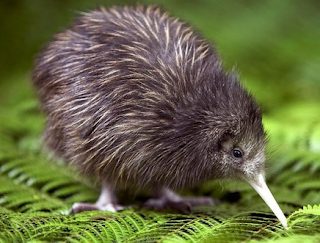
Kiwi Bird

Kingdom      :Animalia Phylum         :Chordata Class             :Aves Clade            :Novaeratitae Order           :Apterygiform...